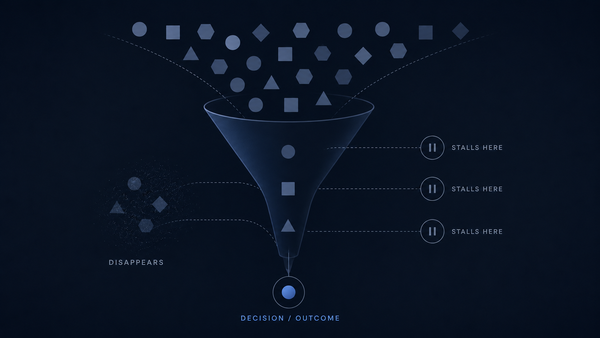
The Cultural Implications of the RDS Decision Funnel™
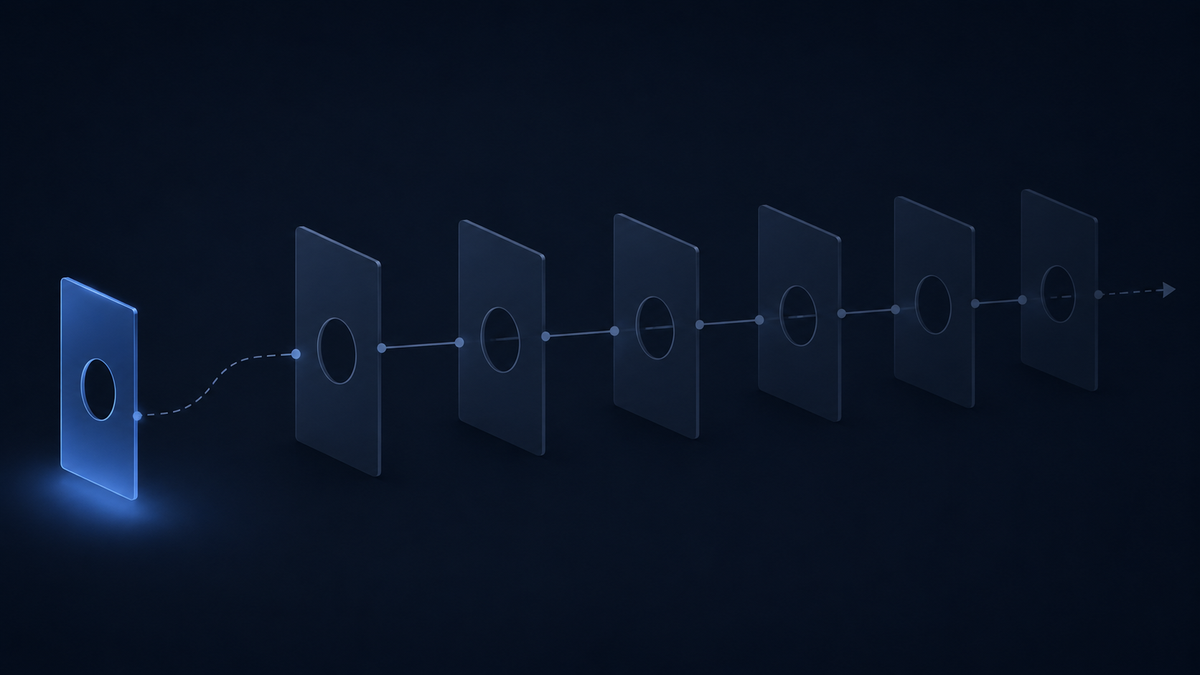
Say for example a software purchase request for $75k in a government entity. To some organizations, $75k is a rounding error, so modify that amount in your perspective to whatever number you feel is a threshold to be a sizable investment, something that will be audited and require a defensible decision trail. In the example environment, that request has to hit enterprise architecture, security, technology procurement, regular procurement, and a myriad of other requirements to even be feasible.
How many decision-makers does that have to touch? Guess… I'll wait…
What I've seen is:
- Requestor (business owner)
- Procurement
- Enterprise Architecture
- Security & Governance
- Legal
- Budget
Six gates (and that's a modest estimate) — in some agencies you can double it.
Sequencing is the first step here — those six gates are not created equal, and the current process is almost never intentional. Like a lot of organizational debt, and things got the way they are because they got that way over time. The RDS Decision Funnel™ does one thing to fix this: it identifies your most likely "no" and puts it first.
Find your hardest gate. Route there first.
Think of this like one of those old shape puzzles. Instead of doing one shape at a time, stack them all together and fine the order and configuration where you can see lights through. Then we rearchitect the process considering those constraints. In effect, you've retrained the organization to understand what fits and what doesn't - you've operationalized and codified institutional knowledge that used to be in a one or two people's heads.
Where your hardest gate lives depends on your organization's current focus. Is the pendulum swinging toward fiscal discipline and cost-minimization? Or are you in a cycle where big sweeping change is supported from the top down and the need becomes speed and agility?
In the example above, let's say the agency is in a budget minimization cycle. The most likely "no" is Budget. So, update the decision architecture to route there first, and add minimum decision criteria around what Budget actually needs to say yes:
- How does this align to the agency's core business?
- What's the cost-benefit analysis for an investment this size?
- What are the switching costs?
- How stable is the cost over the next five years?
- Who is aligned with this at the leadership level — and who is the executive sponsor?
Item 5 on this list, tends to drive the complexity one way or the other. An engaged, enthusiastic sponsor will clear hurdles along these decision routes ahead of time. Other times, the process itself will carry the burden of informing & aligning stakeholders to more than a budget conversation. A $75k request with a deputy director's name attached to it is a different conversation entirely.
In this example, if the request covers those five inputs, Budget will be a breeze. And once you've cleared your hardest gate with minimum viable inputs, you can work backwards through every other decision-maker's requirements and standardize the inputs for that decision type. Document this, educate the upstream stakeholders, reorder the gates and you've turned minefield into a highway.
What happens when you hold the line
Once you stand up even one decision gate with clear minimum viable inputs, two things happen immediately.
First, you'll get grumbling. People will try to get around the process — a quick Teams message to a friendly face in procurement, a request submitted without the required inputs, someone invoking urgency to skip the line.
Don't. Do. It.
Everybody fills out the minimum viable inputs. Same as anybody else. No exceptions for seniority, urgency, or familiarity. When leadership tries to jump, pull the decision makers together and ask directly for the minimum viable inputs, describe the consequences during the next audit, etc. Don't give into the pressure. Generally, the friction of getting these decision-makers together is enough of a deterrent from scheduling delay and forcing them into an uncomfortable posture in front of their peers that it's the path of least resistance to actually follow the process. The moment you make one exception the process is effectively over — you've just demonstrated that the gate is optional for the right people.
After a few rejections, someone will raise a stink. This is where your training materials come in. Walk them through the decision process. Show them how their inputs make the process move, and where it gets hung up when those inputs are missing. They might feel like this is punitive — so be careful to frame it and treat it as a practical one. "Here's what the process requires. Here's why. Here's how to get it through next time."
The process ends up preventing many uncomfortable conversations, and shifts the remaining ones to better requests. The workaround attempts become less frequent and get handled with a gentle redirect. Requestors start thinking ahead — not because they've become more conscientious, but because they've felt the pain of the process when they don't.
Two things are going to happen at the leadership level:
- Leadership is going to get nervous, or relieved, that decision volume is reduced
- Requestors are going to start thinking ahead because they feel the pain of the process when they don't
This level of ownership is the critical building block for a larger decision culture.
This is how you build a decision culture.
A culture that supports risk decisions is more efficient and more likely to be trusted by senior leadership, the board, and stakeholders. Every decision that moves through the RDS Decision Funnel™ gets documented in your decision system of record. Over time you're not just processing requests — you're building an institutional memory of how your organization makes decisions, what inputs it requires, and what outcomes followed.
After a while that thinking muscle develops. You start documenting decisions and looking back to see how well you did. Patterns emerge. You get better at predicting where the next hiccup will be before it happens.
That's a mature decision culture. And it starts with one gate, one decision type, and the discipline to hold the line when someone tries to go around it.
I built a course around this.
Your Risk Decision System™ is a 30-day framework for mapping your organization's decision anatomy, identifying where your influence gaps are, and building a reusable toolkit you can deploy the next day. It's built for security and risk practitioners in state and local government, higher ed, and large regulated organizations — people who carry risk responsibility and need the org to move with them, not around them.
The RDS Decision Funnel™ is the core of it. Everything else — the influence mapping, the ownership layer, the escalation design — hangs off of that.
If you're an ISO, security advisor, or risk practitioner who's watched good decisions disappear, this is built for you. If you're a CISO who needs your team to bring you better signal and fewer problems you have to solve yourself, this is built for you too.
Sign up for the list below:
About the Author
Andrew Sweeney advises large, regulated and government organizations on AI governance, risk, and decision architecture through executive education and strategic advisory services. His 15+ years of experience spans Fortune 500 supply chain transformation and enterprise architecture, information technology, and cybersecurity for government & highly-regulated organizations.
Andrew is especially fascinated by how organizations make decisions under complexity and how emerging technologies influence governance, operations, and human behavior. Outside of his advisory work, he enjoys boating, traveling the U.S. with his spouse and children, and writing music.