Where Decisions Go to Die
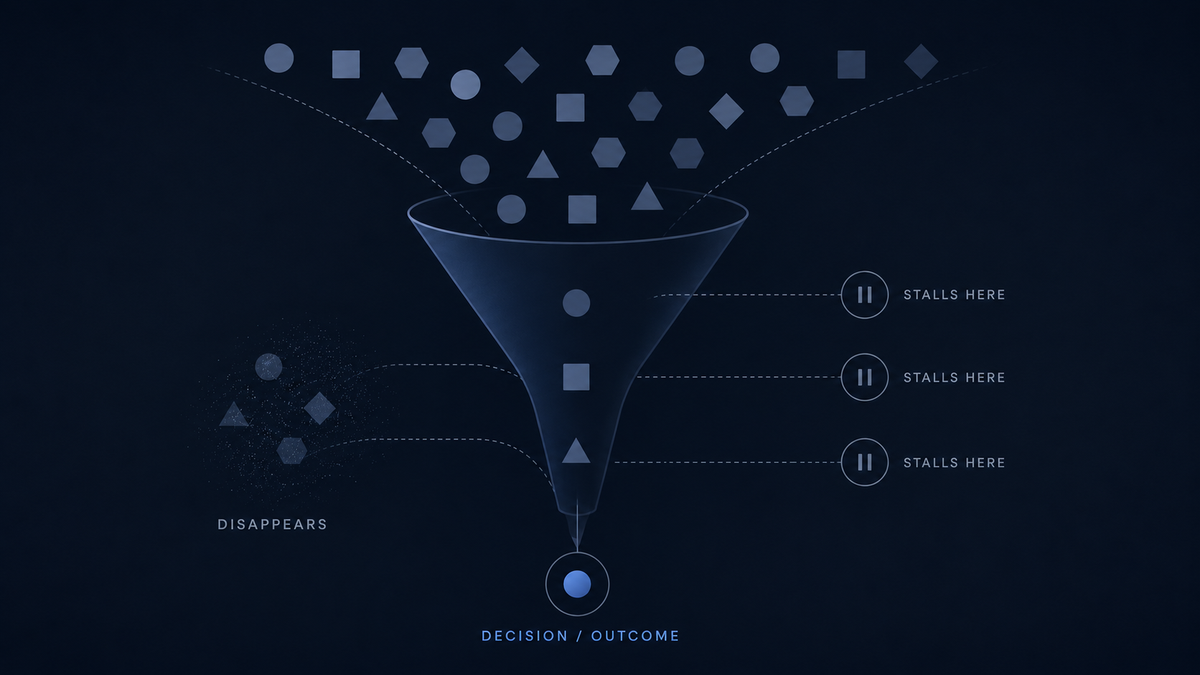
You're living in a risk decision system today whether you like, trust, or know it.
Most organizations have two modes: nothing gets escalated to leadership, or everything does. Both are symptoms of the same problem — nobody has mapped where decisions actually go, who owns them, or where they stall. The org chart says one thing. The decision reality says another.
I've spent the last decade and a half watching good ideas, sound recommendations, and legitimate risk concerns disappear into that gap. Audit findings that recur because nobody owns the fix. Shadow IT that spreads because the approval process is slower than the workaround. Security incidents that don't get reported correctly because nobody knows who's supposed to decide what. These aren't knowledge failures. The people involved usually know exactly what should happen. They're organizational failures — and they're invisible until something breaks.
The RDS Decision Funnel™ is how you make them visible.
The core insight is simple but counterintuitive: every organization already has a decision funnel whether they designed one or not. Requests come in, hit various gatekeepers, stall at certain points, and either surface to leadership or disappear. The funnel exists. It's just unmapped, inconsistent, and full of gaps where decisions go to die.
What I built — and deployed inside a large state agency — is the Risk Decision Systems Framework™ (RDSF™): a structured methodology for mapping that funnel, identifying where the bottlenecks are, and designing minimum viable inputs that move decisions through without requiring heroic effort from the people submitting them. The result at that agency: a 60% reduction in low-signal exception requests, and the 40% that made it through arrived with defensible options and traceable reasoning.
That's not a technology problem solved with a new tool. It's a decision architecture problem solved with structure.
The RDS Decision Funnel™ works by doing one thing most governance frameworks don't: it identifies your most likely "no" first and routes decisions there before anywhere else. If your organization is in a cost-minimization cycle, budget is probably your hardest gate. Design your decision criteria around that gate first. Cover those inputs before the request goes anywhere else. Once you do that consistently, two things happen: decision volume drops because requestors stop submitting things that won't clear the first gate, and the decisions that do come through are higher quality because the process trained them to think ahead.
After a while that's not a process anymore. It's a culture.
I built a course around this.
Your Risk Decision System™ is a 30-day framework for mapping your organization's decision anatomy, identifying where your influence gaps are, and building a reusable toolkit you can deploy the next day. It's built for security and risk practitioners in state and local government, higher ed, and large regulated organizations — people who carry risk responsibility and need the org to move with them, not around them.
The RDS Decision Funnel™ is the core of it. Everything else — the influence mapping, the ownership layer, the escalation design — hangs off of that.
If you're an ISO, security advisor, or risk practitioner who's watched good decisions disappear, this is built for you. If you're a CISO who needs your team to bring you better signal and fewer problems you have to solve yourself, this is built for you too.
Sign up for the list below:
About the Author
Andrew Sweeney advises large, regulated and government organizations on AI governance, risk, and decision architecture through executive education and strategic advisory services. His 15+ years of experience spans Fortune 500 supply chain transformation and enterprise architecture, information technology, and cybersecurity for government & highly-regulated organizations.
Andrew is especially fascinated by how organizations make decisions under complexity and how emerging technologies influence governance, operations, and human behavior. Outside of his advisory work, he enjoys boating, traveling the U.S. with his spouse and children, and writing music.